English 9

4. Read the article and answer the questions.

Each traveler took a different route based on their destination and travel style. The map would show the exact routes they followed.
The traveler who doesn’t know where his next destination is could be someone who prefers spontaneous travel, possibly Colin Wright.
The traveler who doesn’t know how he is going to get to his next destination might be someone who relies on last-minute planning or flexible transport options

One refers to the one bag that Colin Wright takes on his trips.

Four might refer to the number of continents or countries visited.

Twenty-four and twenty-four-hour could relate to time zones or travel schedules.

Twenty-six could refer to the number of destinations visited.

102 and 112 might be the number of flights taken or countries visited.

1) I would most like to visit a country with beautiful landscapes and culture, such as Japan or Italy. I would least like to go to a very remote or unsafe place because of safety and comfort reasons.

2) I would most like to try traveling by train because it’s scenic and comfortable. I would least like to travel by hitchhiking because it seems risky.

3) Advantages of this lifestyle include experiencing new cultures, adventure, and personal growth. Disadvantages include instability, lack of routine, and possible travel fatigue.

1) I’ve never crossed a river in a small boat.

2) I’ve visited the sights in Rome.

3) I’ve booked a hotel room online.

4) I’ve taken a ferry.

5) I’ve missed the school bus.

6) I’ve taken the wrong train.

7) I’ve never left a holiday destination without losing something.

1) 24-hour journey

2) Check-in desk

3) Departure lounge

4) Double-decker bus

5) Express train

6) Fishing boat

7) Overhead locker

8) Passport control

9) Traffic jam

1) On school days, what time do you set off in the morning?

2) Have you ever picked up a bag that wasn’t yours at a friend’s house?

3) What was the last time an airport you went to checked in your bag?

4) When was the last time you got off a bus at the wrong stop?

5) Are you good at dealing with unexpected situations?
English 9

a. In ancient times, fires were lit to use smoke as a signal over long distances.

b. Morse code was invented by an American called Samuel Morse.

c. The world’s first television images were shown to scientists in Scotland in 1926.

d. Radios were used to broadcast coded messages during the Second World War.

e. The World Wide Web was designed originally to make it easier for nuclear physics researchers to communicate.

f. Buying books and CDs over the Internet was made popular by the company Amazon.

g. The first mobile phones with cameras were sold in Japan.

h. Vinyl albums and tapes were replaced by CDs, which are now being replaced by MP3s.

i. The first English dictionary was written by Robert Cawdrey in 1644.

English 9

If I could change one important thing in my country, it would be the education system. Education is the cornerstone of a nation’s progress and development, and while my country has made significant strides in this area, there are still several aspects that need improvement. Specifically, I would focus on reforming the curriculum to emphasize critical thinking, creativity, and practical skills rather than just rote memorization. One of the most pressing issues in the current education system is the memorization and standardized testing. While memorizing facts may be necessary in some contexts, it is more important for students to learn how to think critically and solve problems. Another area where change is needed is in fostering creativity. The current education system often values conformity over innovation, which can students’ creative potential. Creativity is a vital skill in today’s fast-changing world, especially in fields like technology, business, and the arts. Every student learns differently, and the current system does not always account for these differences. Some students excel in certain subjects while others struggle, and the one-size-fits-all approach can leave many behind. A more personalized approach to education, where teaching methods are individual needs and strengths, could help all students reach their full potential. This could involve more project-based learning, where students work at their own pace and focus on areas that interest them. Personalized learning would create a more inclusive and effective education system, where all students have the opportunity to succeed. In conclusion, if I had the power to change one important thing in my country, it would be to reform the education system. By focusing on critical thinking, creativity, practical skills, and personalized learning, we could create an education system that prepares students.

English 9

1.Colin Wright took USA, Argentina, New Zealand, Thailand, Cambodia, Iceland, Romania.

Charley Boorman took Ireland, UK, France, Switzerland, Austria, Italy, Croatina, Serbia, Bulgaria, Turkey, Georgia, Azerbaijan, Iran, United Arab Emirates, India, Nepal, China, Vietnam, Laos, Cambodia, Tailand, Malaysia, Borneo, Bali, West Timor, Australia.

2.Colin Wright doesn’t know where his next destination is.

3.Charley BooTman doesn’t know how is going to get to his next destination.

1.Four refers io months that Colin Wright stays

2.102 refers ko days that Charley Bororman stays.

3.112 refers o means of transport that he uses.

English 9

1A. omplete the reported yes/no questions

a) ‘Have you done your homework?’
→ The teacher asked me if I had done my homework.

b) ‘Are we starting a new lesson?’
→ I asked the teacher if we were starting a new lesson.

c) ‘Are you paying attention?’
→ The teacher asked me if I was paying attention.

d) ‘Do I have to write it down?’
→ I asked the teacher if I had to write it down.

e) ‘Are you feeling all right?’
→ The teacher asked me if I was feeling all right.


1B. Rewrite the sentence as direct speech

f) I asked the teacher if she had a spare pen.
→ I asked the teacher, «Do you have a spare pen?»

g) The teacher asked me if I was going to start.
→ The teacher asked me, «Are you going to start?»

h) I asked the teacher if it was all right to use a pencil.
→ I asked the teacher, «Is it all right to use a pencil?»

i) The teacher asked me if I knew the answer.
→ The teacher asked me, «Do you know the answer?»

j) I asked the teacher if it was the end of the lesson.
→ I asked the teacher, «Is it the end of the lesson?»

1a

C the thicher task me im playing attention

English 9

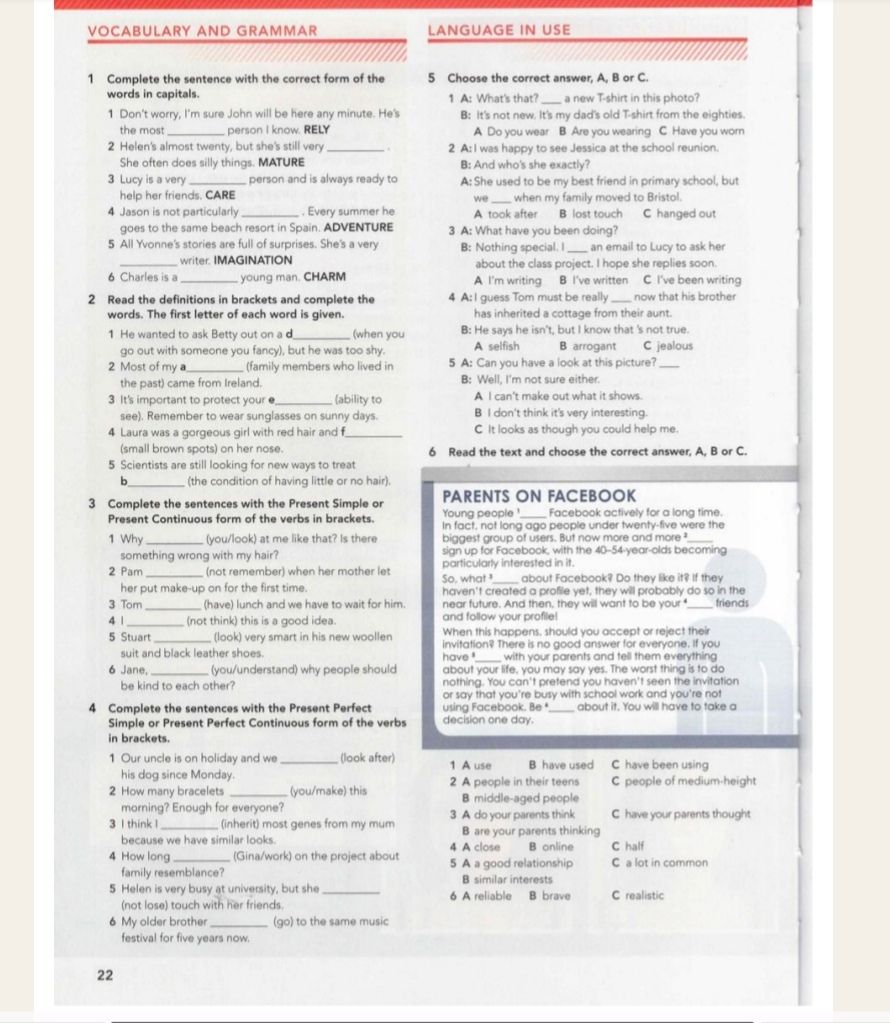
Don’t worry, I’m sure John will be here any minute. He’s the most reliable person I know. (RELY)
Helen’s almost twenty, but she’s still very immature. She often does silly things. (MATURE)
Lucy is a very caring person and is always ready to help her friends. (CARE)
Jason is not particularly adventurous. Every summer he goes to the same beach resort in Spain. (ADVENTURE)
All Yvonne’s stories are full of surprises. She’s a very imaginative writer. (IMAGINATION)
Charles is a charming young man. (CHARM)

Galileo

As well as being a scientist, Galileo was interested a in painting and music. He started his studies b at medical school in Padua. Unlike most scientists at that time, who usually relied c on discussing the facts, not trying to prove them, he recognized the importance d of doing experiments to prove the facts. He is famous e for dropping different weights from the Tower of Pisa to prove that all bodies fall at the same rate, though this is probably not a true story. Through practice, he also became good f at observing the stars, and identified craters on the Moon, sunspots, and the moons of Jupiter. As a result g of studying the planet Venus, he succeeded h in proving that Copernicus was correct, and that the Earth moved around the Sun. Unfortunately, the Church authorities accused him i of publishing unacceptable ideas. In the end he was forced to choose j between being punished by the Church, or denying his own ideas. He spent most of the last nine years of his life imprisoned in his own house.

Galileo

As well as being a scientist, Galileo was interested
a in painting and music. He started his studies b at medical school in Padua. Unlike most scientists at that time, who usually relied c on discussing the facts, not trying to prove them, he recognized the importance d of doing experiments to prove the facts. He is famous e for dropping different weights from the Tower of Pisa to prove that all bodies fall at the same rate, though this is probably not a true story. Through practice, he also became good f at observing the stars, and identified craters on the Moon, sunspots, and the moons of Jupiter. As a result g of studying the planet Venus, he succeeded h in proving that Copernicus was correct, and that the Earth moved around the Sun. Unfortunately, the Church authorities accused him i of publishing unacceptable ideas. In the end he was forced to choose j between being punished by the Church, or denying his own ideas. He spent most of the last nine years of his life imprisoned in his own house.