My neighborhood

My neighborhood is very peaceful and quiet. It is a new neighborhood, and there are a lot of big houses and some apartment buildings. The streets are very clean, and there aren’t many cars. My school is near my house. I can walk there in 10 minutes.

There’s also a park, which has a small playground for children and a large field. I like to play baseball there with my friends after school. All of the houses have a small front yard but big back yards. Most of my neighbors have a swimming pool, and some even have a trampoline!

Everyone has a flower garden, and in the spring, it is very beautiful. My road is called Maple Road. It is not in the city. It’s in the suburbs. There aren’t any restaurants, bars or cinemas on my road. But, if you go to Main street, you can find a lot of things to do. My favorite store is there. It’s called Knick-Knack, and they sell everything you can imagine.

I like my neighborhood because it is very safe. There is no crime, and all of my neighbors take care of each other. The police station is next to the school, which is very nice. However, the hospital is quite far. It is in the city, and we have to drive 30 minutes to get there.

My friends live near me, and we often meet up to play or just talk. We love playing hockey in the street because there isn’t any traffic. I think I am lucky to live in my neighborhood.

The text is about a peaceful and safe neighborhood. It is in the suburbs, where there are big houses, clean streets, and few cars. The writer’s school is close to home, and he plays with his friends in the park. Everyone in the neighborhood cares for each other, and the writer likes living there.

English

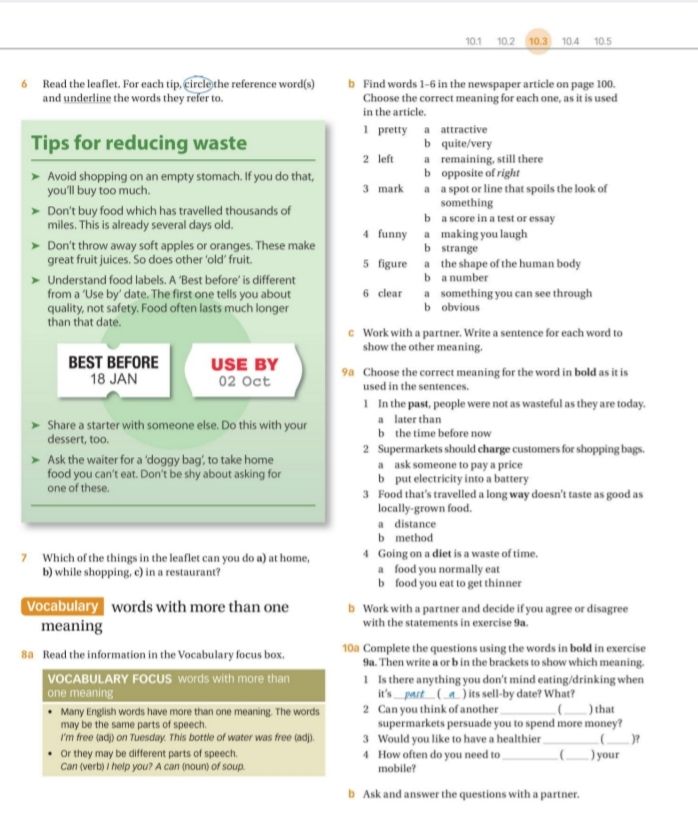
1.describes somebody who uses their left hand to write
→ left-handed
another word for beautiful or handsome
→ good-looking
the opposite of part-time
→ full-time
an adjective which means that something lasts two minutes
→ two-minute
describes a shirt which has short sleeves
→ short-sleeved
describes a person who works hard
→ hard-working

2.easy + going → easy-going
home + made → home-made
five + star → five-star
over + priced → overpriced
second + hand → second-hand
well + known → well-known
English + speaking → English-speaking
500 + page → 500-page

4.easy-going home-made five-star overpriced second-hand well-known English-speaking 500-page

English 10

Example Matching (how it usually works)

If phrases 1–6 are something like:

  1. You must wear a uniform → a (strong obligation)
  2. You mustn’t smoke here → b (prohibition)
  3. You don’t have to come → c (no obligation)
  4. I had to study yesterday → d (past obligation)
  5. I will have to work tomorrow → e (future obligation)
  6. You should see a doctor → f (advice)

obligationno obligationprohibitionpast / future obligationadvice

2)

He was reliable and punctual. When he was working in the burger van, he had to work on time. He also had to be polite to the customers. However, the job didn’t have to take much responsibility as his boss dealt with the difficult situations.

He had to get up early because the van opened at 11 am. When he wanted to, he didn’t have to take days off.

Now that he has changed to a new job, things are different. Although he likes it, it affects his life because it is a very high-pressure job, so he has to work to tight deadlines. However, he doesn’t have to work outside, which is nice.

3)

Communication skills
→ I acquired this skill at school by talking to classmates and teachers. Teamwork
→ I learned this by working on group projects. Time management
→ I developed this skill by doing my homework on time. Problem-solving
→ I got this skill by solving difficult tasks and exercises. Responsibility
→ I learned this by completing my duties at school and at home. Computer skills
→ I acquired this by using a computer for studying.

English 10

I found some old newspapers while I was tidying up the attic recently.
“while” = two actions happening at the same time

I almost fell asleep during the meeting this afternoon.
“during” + noun (“the meeting”)

The US belonged to the UK until 1776, when it gained independence.
“until” = up to a point in time

I was looking for my phone. Meanwhile, my wife had found it and was looking for me.
“meanwhile” = at the same time, but different action

We called the police as soon as we discovered the house had been robbed.
“as soon as” = immediately after something

We spent ages looking for the shop and by the time we found it, it was closed.
“by the time” = something already happened before another moment

There were many important discoveries during the 1800s.
“during” + period of time

Luke and I met while we were working together in a café.
“while” = same time actions

2.

Although it’s very popular nowadays, during the 1950s pasta was an unusual meal in the UK. Not many British people had been to Italy, and very few people knew how pasta was made. So, for April Fool’s Day in 1957, the BBC news programme Panorama decided to make a story about spaghetti growing on trees.

During the programme, viewers were told that the harvest that year was particularly good because of the weather. And while the presenter explained how spaghetti was grown, there was a film of workers in the background cutting the spaghetti from the trees.

As soon as the programme had been broadcast, the BBC started receiving phone calls from people who wanted to grow their own spaghetti. Meanwhile, the BBC continued the joke by instructing anyone who wanted to grow a spaghetti tree to “place a piece of spaghetti in a tin of tomato sauce.”

3.

I woke up three times during the night.

Sorry I didn’t speak to you earlier, but I phoned you as soon as I could.

We were very late and the party had finished by the time we got there.

We walked all day until it got dark, and then we went home.

We just couldn’t find the plane tickets. We looked everywhere. Meanwhile, the taxi to the airport was waiting for us outside.

The Worst Day of My Life

The Worst Day of My Life

One of the worst days of my life was the day when I broke my arm. At first, it seemed like a normal day, and I didn’t think anything bad would happen. I was playing and having a good time, but suddenly an accident happened.

At one moment I fell and felt a very strong pain in my arm. At first I didn’t understand what had happened, but the pain became stronger and stronger. When they took me to the doctor, it turned out that my arm was broken. At that moment I felt very scared and sad.

Then the doctors put a cast on my arm, and for a long time I couldn’t move it normally. Those days were very difficult because even simple things were hard to do. But this experience taught me to be more careful and to appreciate my health.

Although that day was very painful and sad, everything got better with time, and now I remember it as an experience that made me stronger.

English 10

The psychology of shopping studies why and how people make purchasing decisions. It explains the factors that influence consumers, such as emotions, advertising, environment, social influence, and personal needs.

First of all, emotions play a major role. When a person feels happy, sad, or stressed, they may go shopping to change their mood. This is called “emotional shopping.” Many stores use music, pleasant scents, and lighting to create a comfortable atmosphere and encourage customers to stay longer and buy more.

Another important factor is advertising. Advertisements often influence our subconscious mind by suggesting that a product will improve our life, increase our confidence, or make us more successful. On social media, bloggers and influencers also strongly affect people’s choices.

Social influence is another key element. People often buy things that their friends buy or that are currently fashionable. This is connected to the desire to feel accepted in society.

Finally, discounts and special offers are very powerful. Signs like “50% off” or “limited time offer” can push people to make quick decisions, even if they do not really need the product.

English 10

Among adult users of Facebook, the average number of friends is 338.

Rob Jones is trying to meet all the friends on his Facebook page in real life. He is travelling to many countries and meeting people face-to-face. His aim is to raise money for a children’s charity.

So far he has already met 123 friends from ten countries. When he meets them, he takes a photo and asks them to give some money to the charity. He has already raised more than £3,000.

Rob hopes to meet all 700 friends within three years. He is travelling thousands of miles to many countries, even to the other side of the world.

Many people say that Facebook friends are not real friends. But Rob does not agree. He met his Polish girlfriend online and they have been together for three years.

Rob says the internet is a powerful tool. He is meeting new people and learning a lot about himself. Now he has good friends in many different countries.

If you want, I can also make

English 10

1)

Do you know any offices that look like these? Where?
Yes, I know offices like these. Some IT companies and call centers in Yerevan use open-plan offices. Many modern companies use this style because it saves space and helps people communicate.

Which type of office would you work best in?
I would work best in a quiet private office because I can concentrate better and do my work faster without noise.

One advantage and one disadvantage of each type of office:

2)

I’m a sales / software developer / journalist.
sales (wrong)
software developer / journalist

2️⃣ I’m studying engineering / scientist / IT.
scientist
engineering / IT

3️⃣ I work as a nurse / politics / a PA.
politics
nurse / a PA

4️⃣ I work for a construction / builder company.
builder
construction

5️⃣ I work in sales / administrator / IT / publishing.
administrator
sales / IT / publishing

6️⃣ I’d like to become accountant / engineering / a nurse.
engineering
accountant / a nurse

English 10

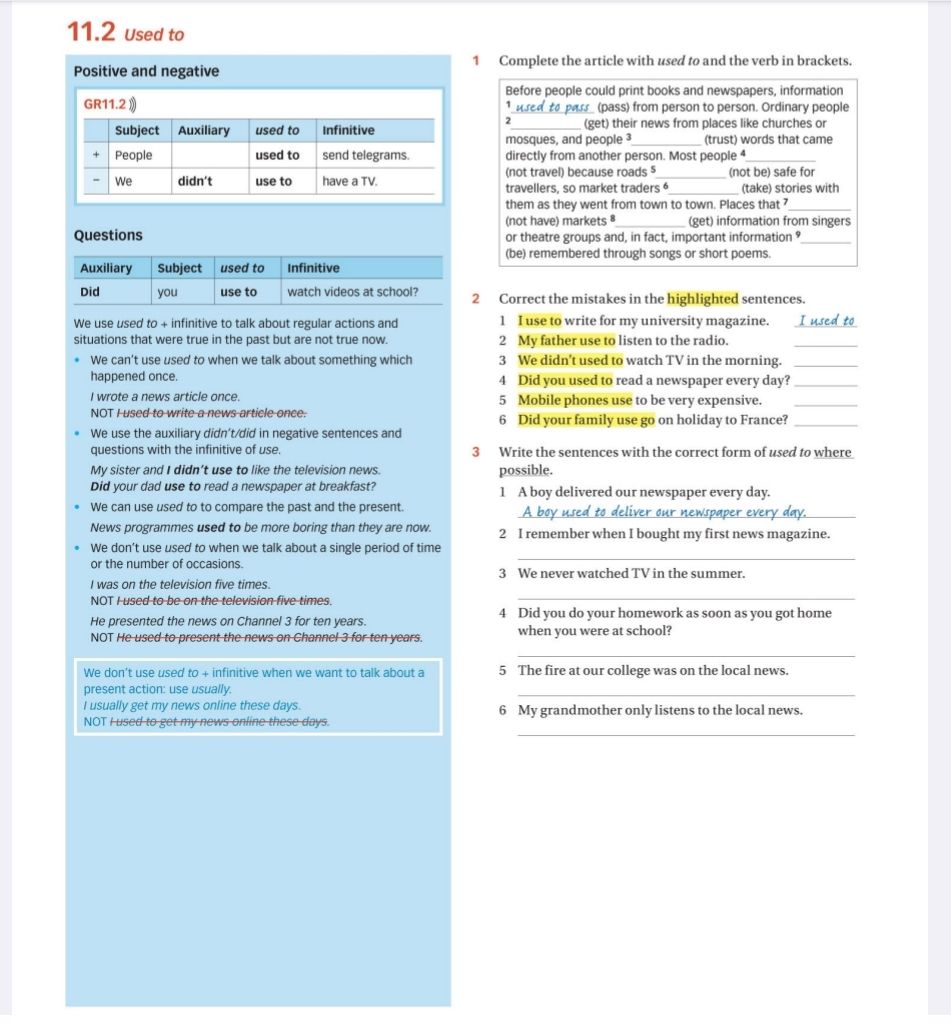
1)Before people could print books and newspapers, information used to pass from person to person. Ordinary people used to get their news from places like churches or mosques, and people used to trust words that came directly from another person. Most people didn’t use to travel because roads weren’t safe for travellers, so market traders used to take stories with them as they went from town to town. Places that didn’t have markets used to get information from singers or theatre groups and, in fact, important information used to be remembered through songs or short poems.

2)

I used to write for my university magazine.

My father used to listen to the radio.

We didn’t use to watch TV in the morning.

Did you use to read a newspaper every day?

Mobile phones used to be very expensive.

Did your family use to go on holiday to France?

3)

Did you use to do your homework as soon as you got home when you were at school?

The fire at our college was in the local news.

My grandmother only listens to the local news.