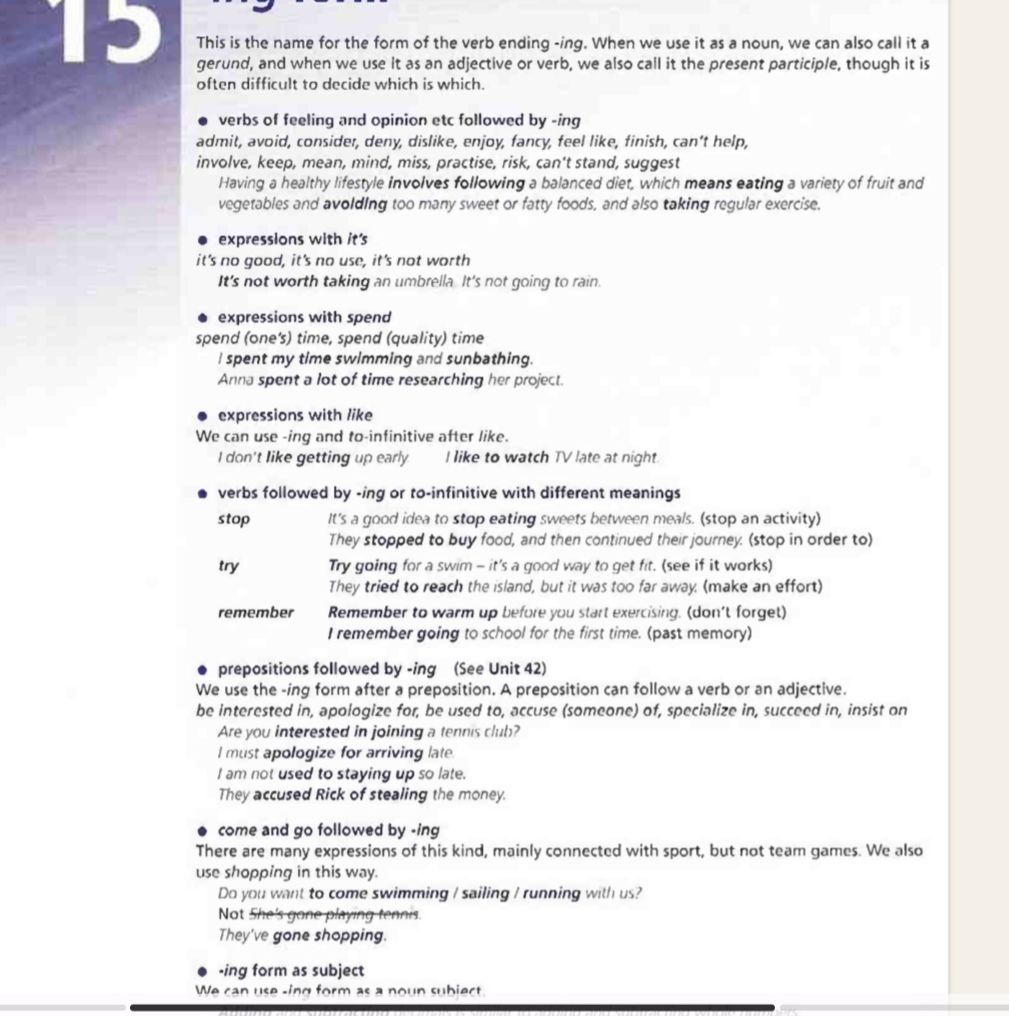
looks like you’ve listed various verb forms that are followed by -ing, expressions with “it’s,” and ways of using “spend” and “like” in sentences. Here’s a quick summary and some examples for each:
Verbs of Feeling and Opinion Followed by -ing:
- Admit: She admitted making a mistake.
- Avoid: I avoid eating too much sugar.
- Consider: Have you considered moving to a new city?
- Deny: He denied breaking the vase.
- Dislike: She dislikes waking up early.
- Enjoy: I enjoy reading books before bed.
- Fancy: I fancy going for a walk.
- Feel like: I feel like eating something sweet.
- Finish: I finished studying for the exam.
- Can’t help: I can’t help laughing at that joke.
- Involve: The job involves travelling a lot.
- Keep: I keep forgetting my keys.
- Mean: What does this word mean by helping others?
- Mind: Do you mind waiting for a few minutes?
- Miss: I miss seeing my friends.
- Practice: He practices playing the piano every day.
- Risk: She risks losing her job by being late.
- Can’t stand: I can’t stand doing the same thing every day.
- Suggest: He suggested going to the beach.
You’ve brought up some great points regarding verbs with different meanings when followed by -ing or to-infinitive, as well as expressions with prepositions, and the use of the -ing form as a subject. Let’s break down each of them:
Verbs Followed by -ing or To-infinitive with Different Meanings:
- Stop:
- -ing: Stop eating sweets between meals. (cease an activity)
- to-infinitive: They stopped to buy food, and then continued their journey. (pause to do something)
- Try:
- -ing: Try going for a swim; it’s a good way to get fit. (experiment with something to see if it works)
- to-infinitive: They tried to reach the island, but it was too far away. (make an effort to do something)
- Remember:
- -ing: I remember going to school for the first time. (a memory of something in the past)
- to-infinitive: Remember to warm up before you start exercising. (don’t forget to do something)
Prepositions Followed by -ing:
We use the -ing form after prepositions, whether they come after a verb or an adjective.
- Be interested in: Are you interested in joining a tennis club?
- Apologize for: I must apologize for arriving late.
- Be used to: I am not used to staying up so late.
- Accuse (someone) of: They accused Rick of stealing the money.
- Specialize in: She specializes in teaching languages.
- Succeed in: He succeeded in passing the exam.
- Insist on: They insisted on leaving immediately.
Come and Go Followed by -ing:
These verbs are often used in expressions related to activities, especially sports or hobbies.
- Come swimming/sailing/running: Do you want to come swimming with us? / Do you want to go sailing this weekend?
- Go shopping: She’s gone shopping with her friends.
- Not: She’s gone playing tennis. (Incorrect usage)
-ing Form as a Subject:
The -ing form can also function as a noun and act as the subject of a sentence.
- Swimming is a great way to stay fit.
- Reading helps improve your vocabulary.
The -ing form in these sentences is the subject, and the sentence talks about the activity itself.
These rules help clarify how verb meanings can change depending on whether they are followed by the -ing form or the to-infinitive, as well as how prepositions and -ing forms work in different contexts. Would you like to see more examples or practice with these structures?
ChatGPT может допускать ошибки. Рекомендуем проверять важную информацию.

 Արտավազդ Մկրտչյան 10 դասարան